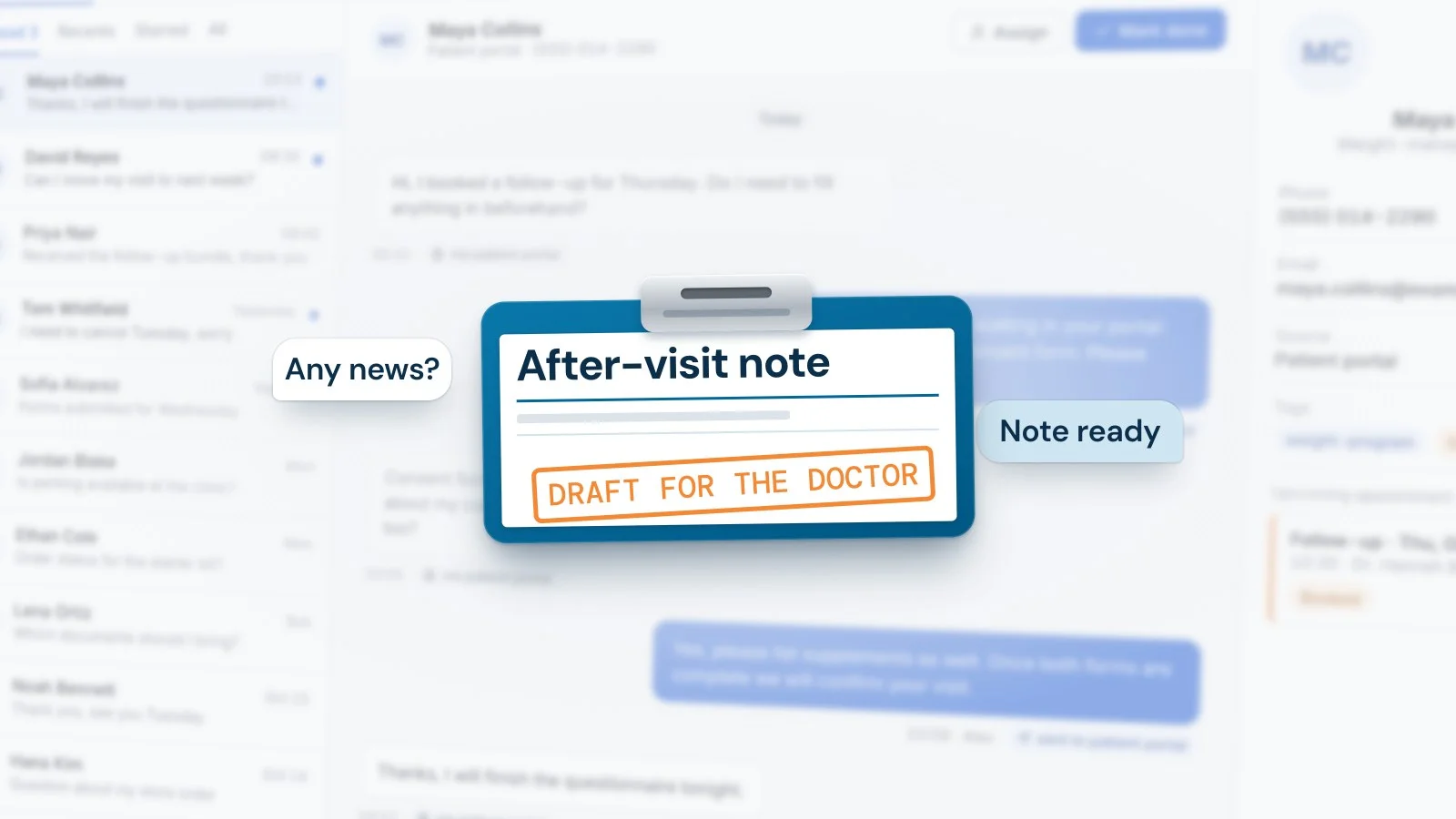
Clinic CRM Integration
Clinic CRM integration for a weight-management clinic and store: visits, forms, chat and orders land in GoHighLevel, with an AI draft note.
- n8n
- GoHighLevel
- Healthie
- WooCommerce
- OpenAI
The business
This is a medical weight-management clinic with its own supplements store. Doctors run consultations and treatment programs. Patients keep their records in a patient portal. The store sells to patients and to regular customers.
The staff live in GoHighLevel: it is the CRM, the inbox and the calendar. Our clinic CRM integration is built around one rule: whatever happens in the portal or the store should show up where the staff already look.
The problem
A patient books a visit in the portal. The front desk, working in the CRM, sees nothing. The patient fills in an intake form, and nobody knows until the doctor opens the portal. A patient writes in the portal chat, a staff member answers from the CRM, and the two halves of the conversation never meet.
The store added a second blind spot. Every order had to be copied into the CRM by hand, so nobody could tell whether the buyer was a patient. After each consultation the doctor started a note from an empty page.
Then the clinic outgrew its first portal, IntakeQ, and chose Healthie. Healthie has a GraphQL API with gaps, and the move had to happen while the clinic kept seeing patients. Every hour of staff time spent on copying data was an hour not spent on patients.
Why not a ready-made connector
The clinic looked at marketplace connectors first. They move a contact from A to B. They do not decide whether a visit is confirmed, keep a chat from echoing forever or write a consultation note. Side by side, the gap is easy to see.
| Copying by hand | Off-the-shelf connector | What we built | |
|---|---|---|---|
| Visits from the portal | Retyped into the calendar | Creates an event, no doctor, no forms check | Event with the doctor assigned, patient matched by email or phone |
| Visit confirmation | Front desk chases forms | Not covered | Confirms itself once the required forms are in |
| Patient chat | Two inboxes | One direction, duplicates | Both directions in one thread, no echo |
| Store orders | Copied into the CRM | New contact per order | Contact, deal, patient check and status sync |
| Consultation note | Written from scratch | Not covered | AI draft for the doctor to edit |
How the clinic CRM integration works
We connected the store, the portal and GoHighLevel with n8n workflows and added an AI note on top. Each part runs on its own trigger, and one thing stays human: a doctor reviews every note.
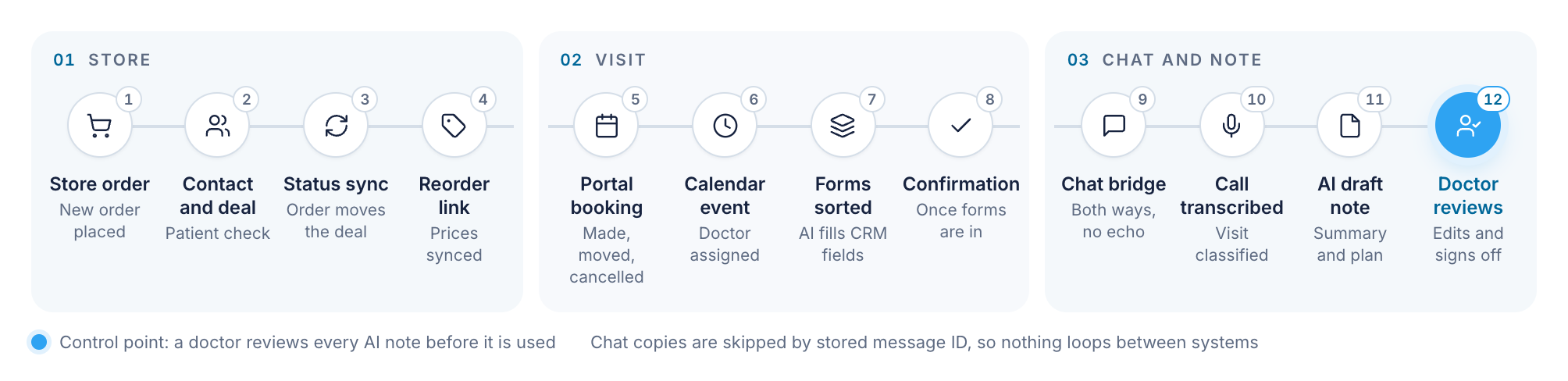
Three routes into one CRM. The doctor's review is the only step a person must do. Redrawn with demo data.
- A store order creates a contact and a deal in the CRM, and a check tells staff whether the buyer is a patient.
- The order and its coupons are written to the sales table.
- When the order status changes in the store, the deal moves to the matching stage, and the other way round.
- Each deal carries a reorder link. Subscriptions are tracked with tags, and products and prices sync on a schedule.
- A visit booked, moved or cancelled in the portal becomes a calendar event, and the doctor is assigned.
- The patient is found in the CRM by email or phone number.
- Intake answers are sorted into CRM fields by AI, and a second pass pulls out figures for analytics.
- When the required forms are in, the visit confirms itself. Cancelled, rescheduled and no-show visits are skipped.
- Chat messages travel both ways between the portal and the CRM thread.
- A consultation call is transcribed, and a classifier decides whether it was a medical consultation.
- For consultations, AI writes a structured note and attaches it to the contact as a draft.
- The doctor edits the draft and decides what goes into the record.
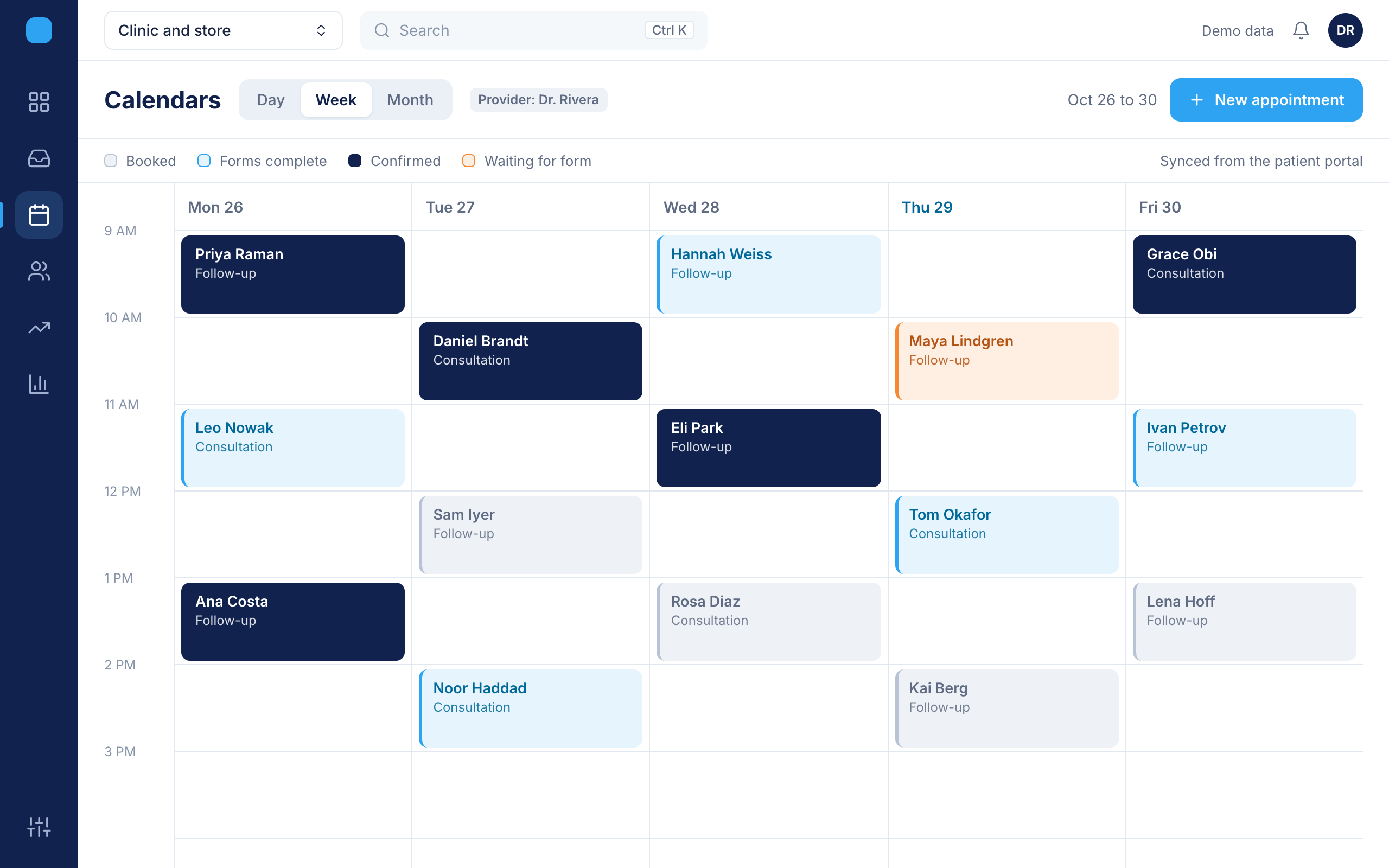
The calendar. Each visit carries its status, and the orange one is waiting for a form. Redrawn with demo data.
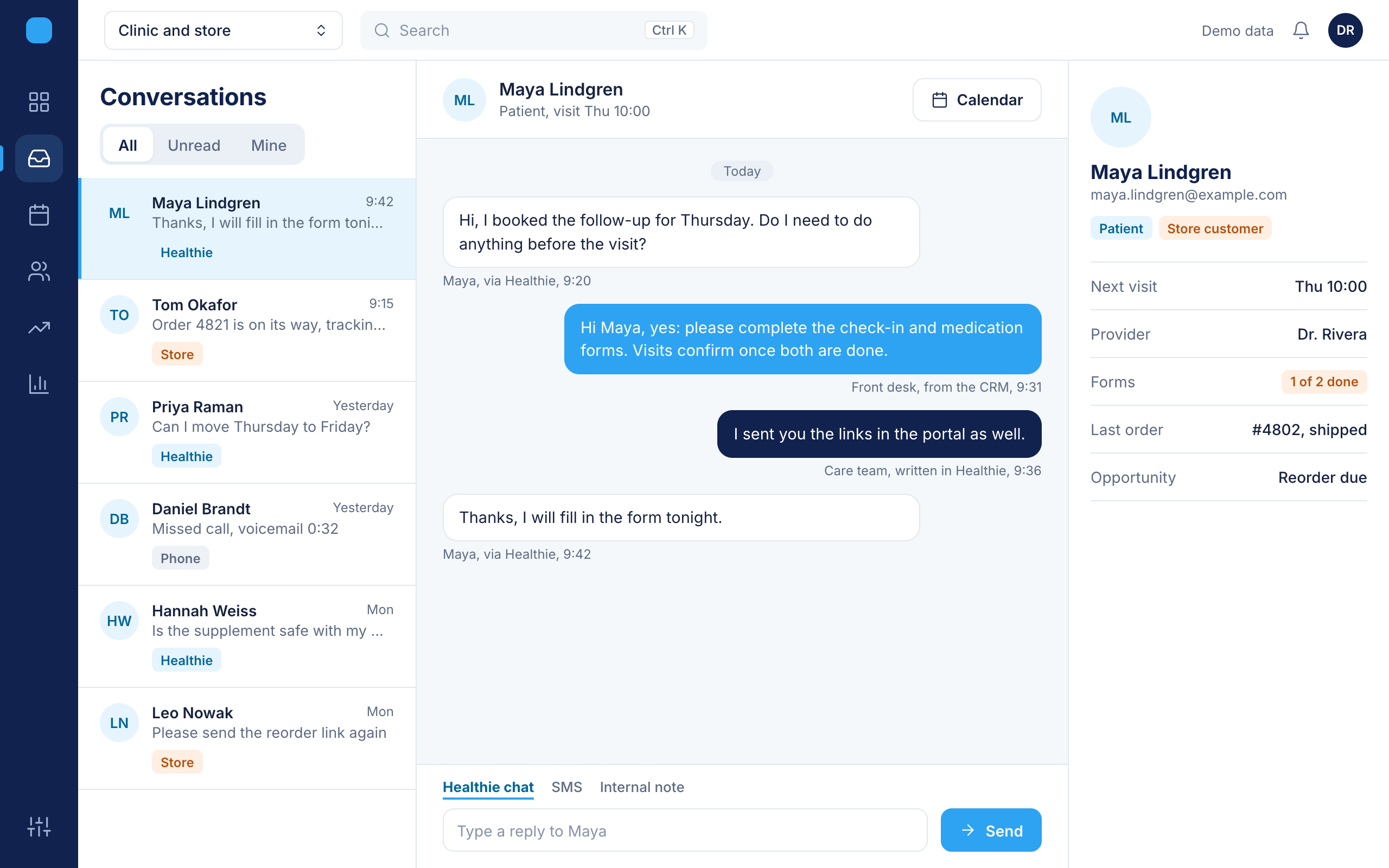
One thread per patient. Portal messages and CRM replies sit together. Redrawn with demo data.
Store orders as deals
The store is the clinic's second front door, and the CRM now treats it that way. Staff see every order as a deal on a board, with the stage matching the order status in the store.
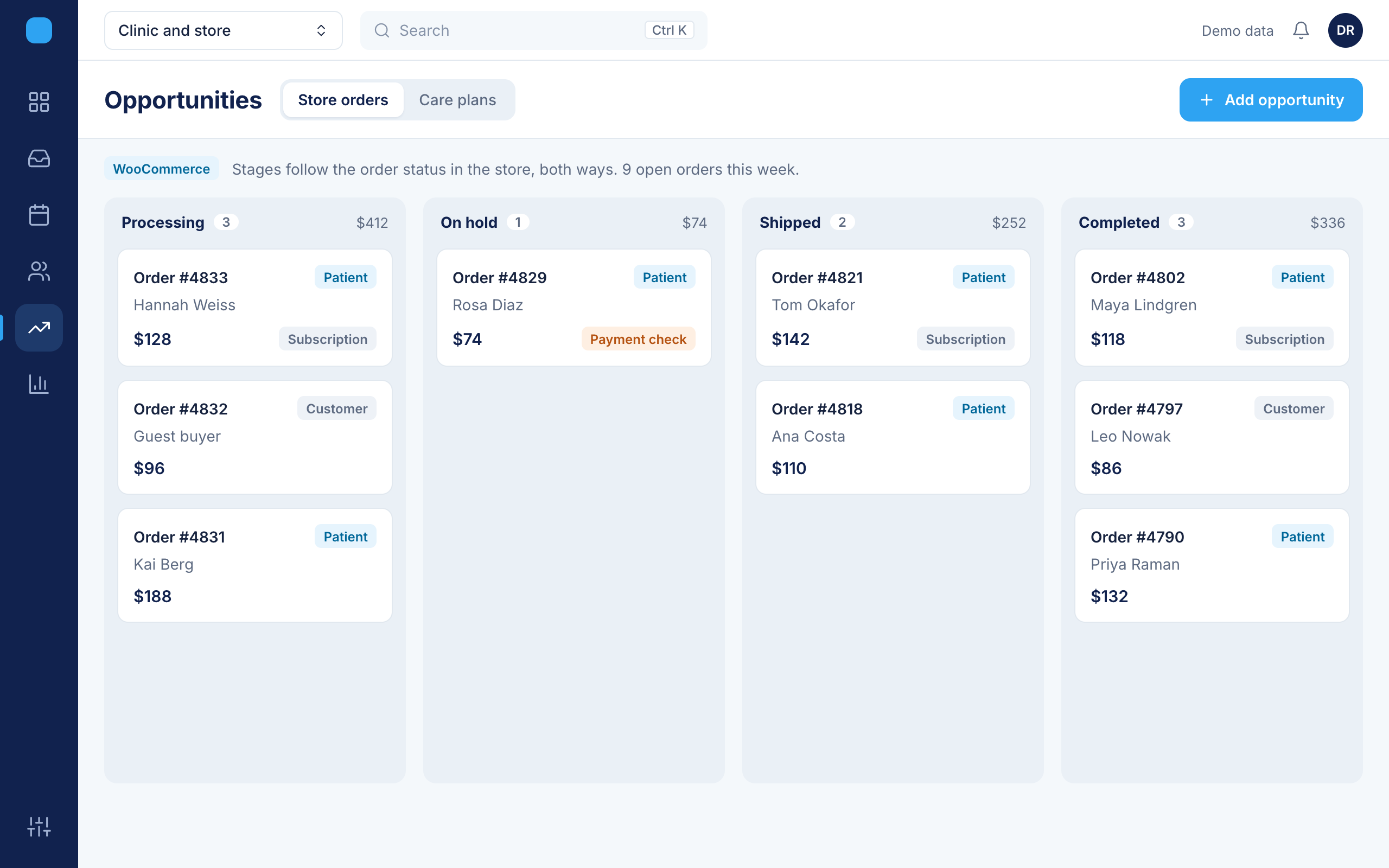
Orders as opportunities. Moving an order in the store moves the card, and the reverse works too. Redrawn with demo data.
The consultation note
A doctor finishes a call and the CRM already holds a draft: summary, plan and follow-up, attached to the contact. Since the first release, the note also reads the patient's visit history and forms from the portal, so it starts from what the clinic already knows.
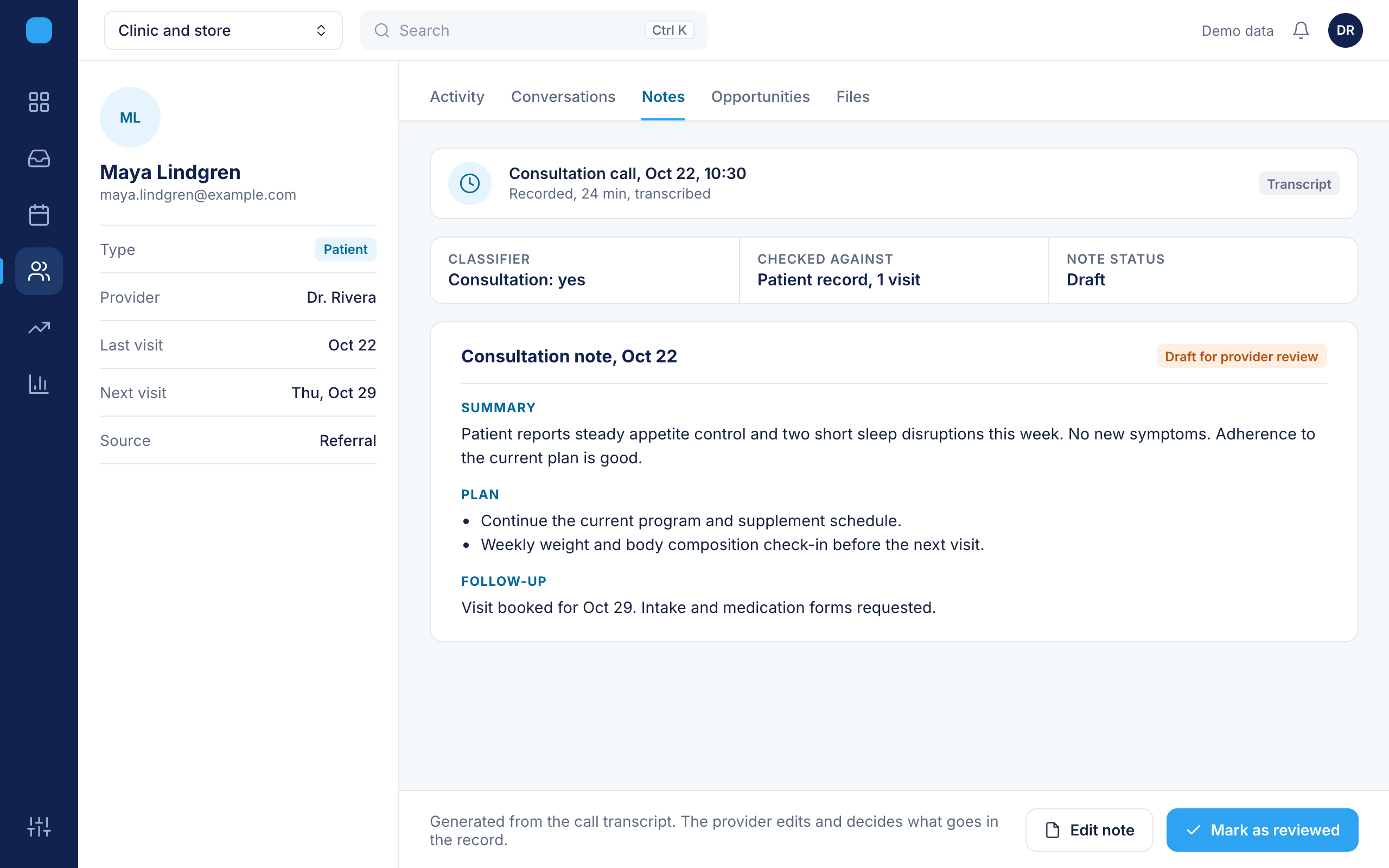
The draft note on the contact. It stays a draft until the doctor reviews it. Redrawn with demo data.
The hard parts
An API with gaps
Healthie's GraphQL API does not cover everything the clinic needs, and this was the hardest part of the project. We built each workflow around what the API allows, so that appointment changes, deletions and chat all work through the same narrow door.
Chat without duplicates or loops
A reply in one system appears in the other, and then comes back as a new message. We store the ID of every message we pass along and ignore our own copies. Messages that staff write directly in the portal also show up in the CRM thread.
One patient, three systems
The same person is in the store, the CRM and the portal with a different spelling of an email or a phone number. We normalize phone numbers first and match on email or phone.
Switching portals while the clinic works
We moved the automations from IntakeQ to Healthie in May 2026 without pausing the clinic. The old and the new portal ran side by side until each workflow was proven, and then the last pieces that depended on IntakeQ moved over. The clinic no longer uses it.
Result
The staff now work in one CRM. Orders, visits, forms and patient messages arrive there without retyping, and doctors begin from a drafted note instead of a blank page. The clinic also reads patient history, medications and patient sources in a Looker Studio dashboard.
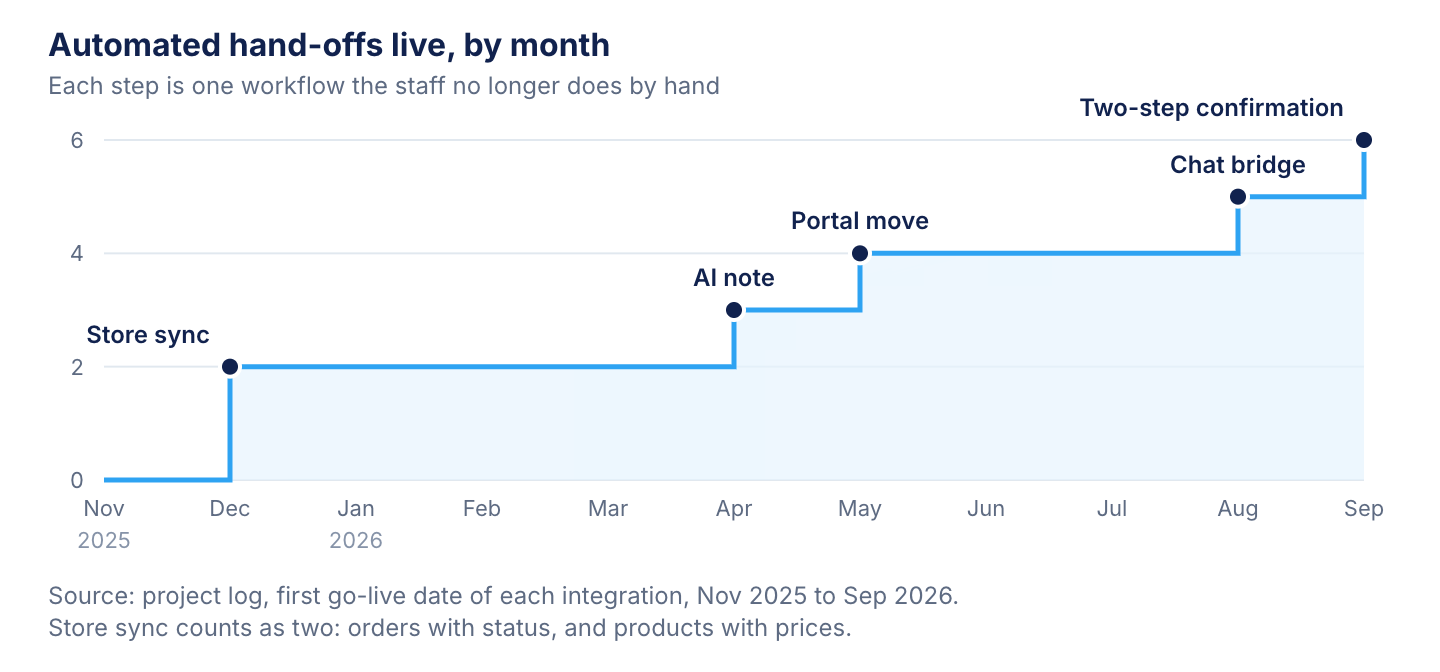
Six hand-offs went live between December 2025 and September 2026. Source: project log.
| Before | After | |
|---|---|---|
| Store orders | Copied into the CRM | Contact, deal and status sync |
| Visits and forms | Checked in the portal | Calendar event, forms sorted, visit confirms itself |
| Patient chat | Two inboxes | One thread |
| Consultation note | Blank page | AI draft for the doctor |
| Patient portal | IntakeQ | Healthie, moved without a pause |
The store integration has run since December 2025, the AI note since April 2026, the chat bridge since August 2026 and the two-step confirmation since September 2026. The staff stopped being the glue between systems.
Our part
Every integration, the AI agents and the analytics were built by us, and we keep supporting them. The doctors and staff make all medical decisions and run the store content. The clinic came back to us directly because we already knew its processes. A related build is the AI phone dispatcher, which also writes into a business's working tool and leaves the decisions to people.
If you are planning a similar build, these two notes go deeper: how to build appointment reminders that survive schedule changes and the autonomy ladder for AI agent permissions.
Running a process like this by hand?
Tell us what your team repeats every week. We reply within one business day with a plan and a price.