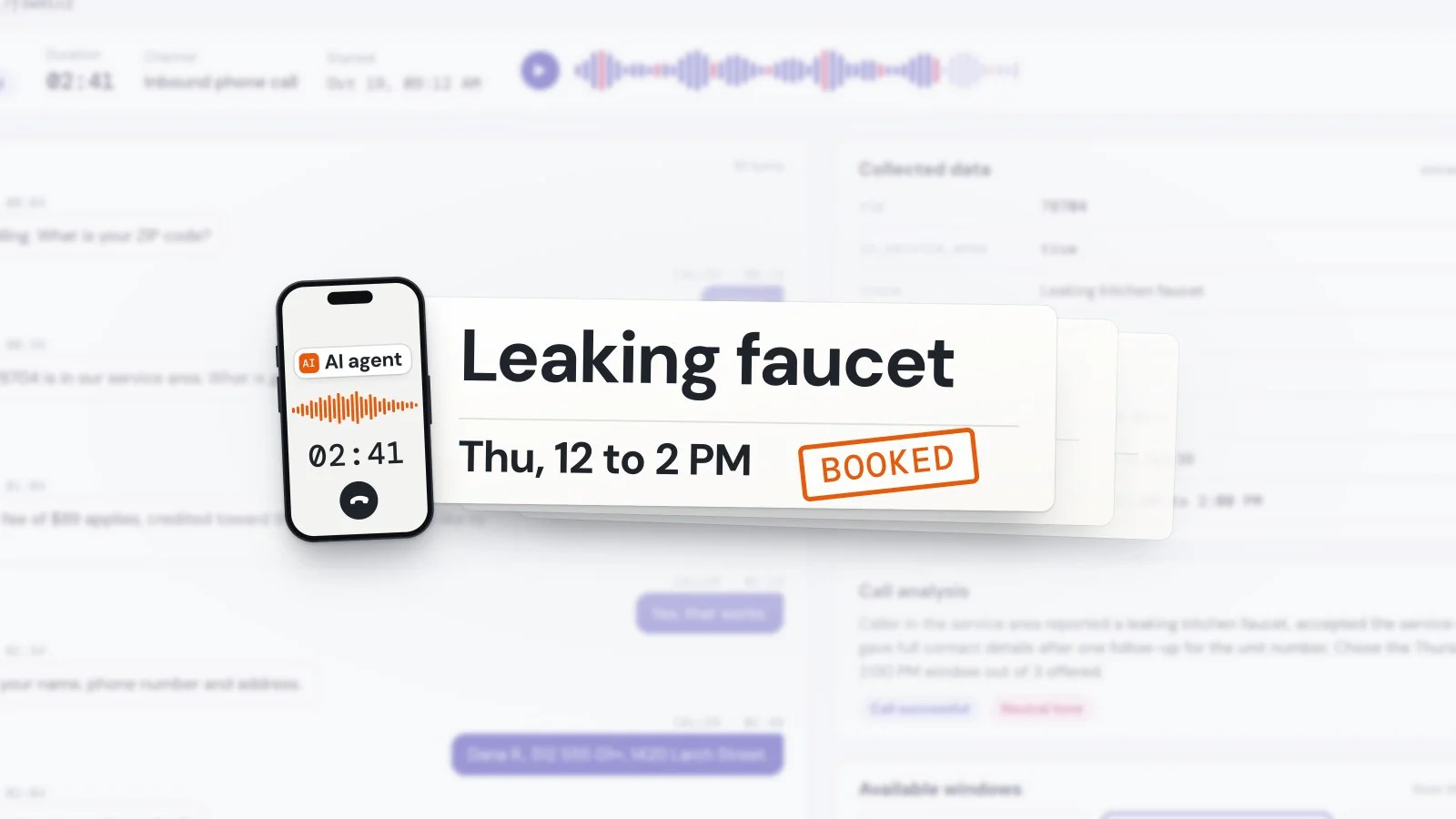
AI Phone Dispatcher for Inbound Calls
AI phone dispatcher for a home-services company: it answers calls, checks the ZIP, explains the fee and books the job in Housecall Pro.
- Retell
- Housecall Pro
- n8n
The business
This home-services company sends technicians to customers' homes for small repairs: a leaking faucet, a jammed disposal, a dead outlet. Jobs and the schedule live in Housecall Pro. Most customers book by phone, and the dispatch for companies like this one is run by a partner who brought us the project.
We built an AI phone dispatcher that answers those calls, checks the address, explains the fee and books the visit into Housecall Pro while the customer is still on the line.
The problem
Every incoming call went to a live dispatcher, and every call needed that person's full attention from the first word to the last. The calls were alike, which is exactly why the work felt like a script: where are you, what broke, here is the fee, name and address please, which day suits you.
A person can only hold one call at a time. When two customers rang within the same few minutes, the second waited or went to voicemail, and a customer with a leaking sink rarely leaves a voicemail. They call the next company in the search results.
The calls that did get answered had a second cost. Some callers lived outside the service area, and the dispatcher found out only after explaining the problem and the fee. Others stopped at the fee. Each of those calls used the same minutes as a booking and produced no job.
On every call the dispatcher worked through the same list:
- asked for the location and whether the company served it;
- asked what had broken and which service was needed;
- explained the visit terms and the fee;
- wrote down the name, phone number and address;
- looked up open windows in Housecall Pro;
- created the customer and the job.
Why not voicemail, a phone menu or an answering service
The company had options short of building anything. Each of them breaks at a different step.
| Live dispatcher | Voicemail or phone menu | Answering service | AI phone dispatcher | |
|---|---|---|---|---|
| Answers while another call is running | No | Records a message | Yes | Yes |
| Checks the ZIP against the service area | By hand, from memory | No | Reads a script, takes a message | Checks the list on every call |
| Explains the fee and hears the answer | Yes | No | Rarely | Yes, then continues or ends the call |
| Offers real open windows | Looks them up | No | No access to the schedule | Reads them from Housecall Pro during the call |
| Creates the job | Types it in | Someone calls back and types it in | Someone types it in later | Created before the call ends |
Each option moved the typing to a later time or to another person. None of them put a booked job into the schedule during the call.
How the AI phone dispatcher works on a call
We built the agent on Retell and connected it to Housecall Pro. It does the dispatcher's six steps in the same order, and it stops early whenever a call cannot become a job.
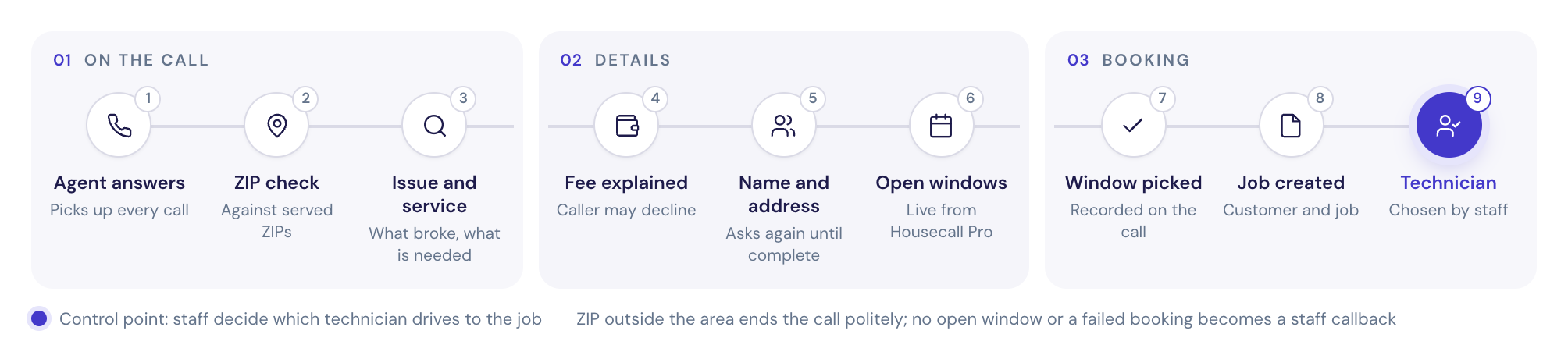
The path of a call. Staff choose the technician, and every failed booking becomes a callback.
- The voice agent picks up the incoming call.
- It asks for the ZIP code and checks it against the list of served ZIPs.
- If the ZIP is outside the area, the agent says the company does not work there and ends the call politely.
- It finds out what happened and which service the caller needs.
- It explains the fee or commission and asks whether the caller wants to go ahead.
- It collects the name, phone number and address. If a piece is missing or unclear, it asks for that piece again until the record is complete.
- It requests open windows from Housecall Pro during the call and offers them to the caller.
- It records the window the caller picks.
- It creates the customer and the job in Housecall Pro.
- Staff open the job and choose the technician.
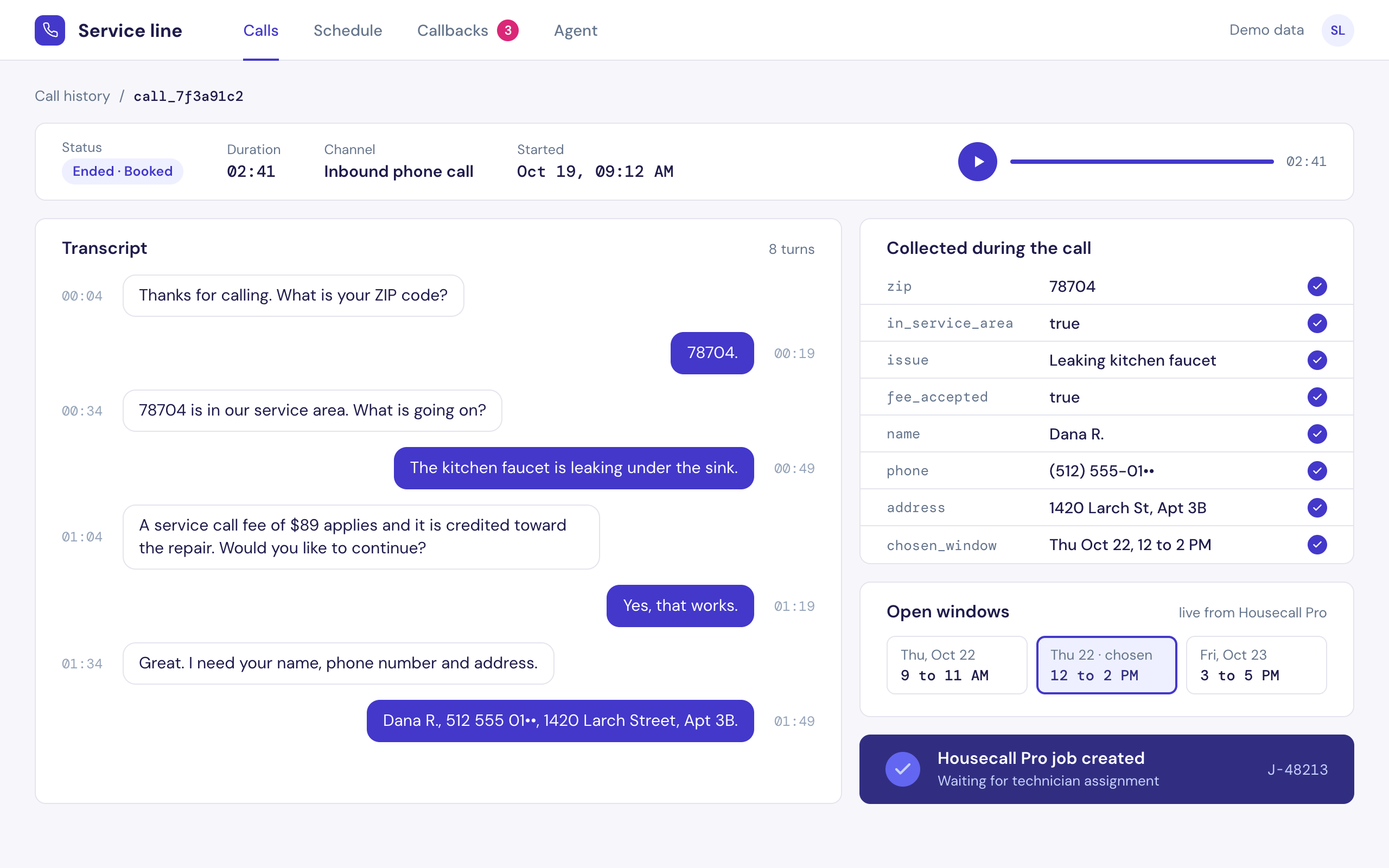
One finished call in Retell: transcript, collected fields and the job it produced. Redrawn with demo data.
From booked call to assigned technician
The agent never decides who drives to a job. That stays with the company, because staff know which technician is closer, who has the right parts and who is already running late.
The job arrives in Housecall Pro with the customer, the address, the issue, the fee note and the window the caller chose. Staff see only one open question, which is the technician.
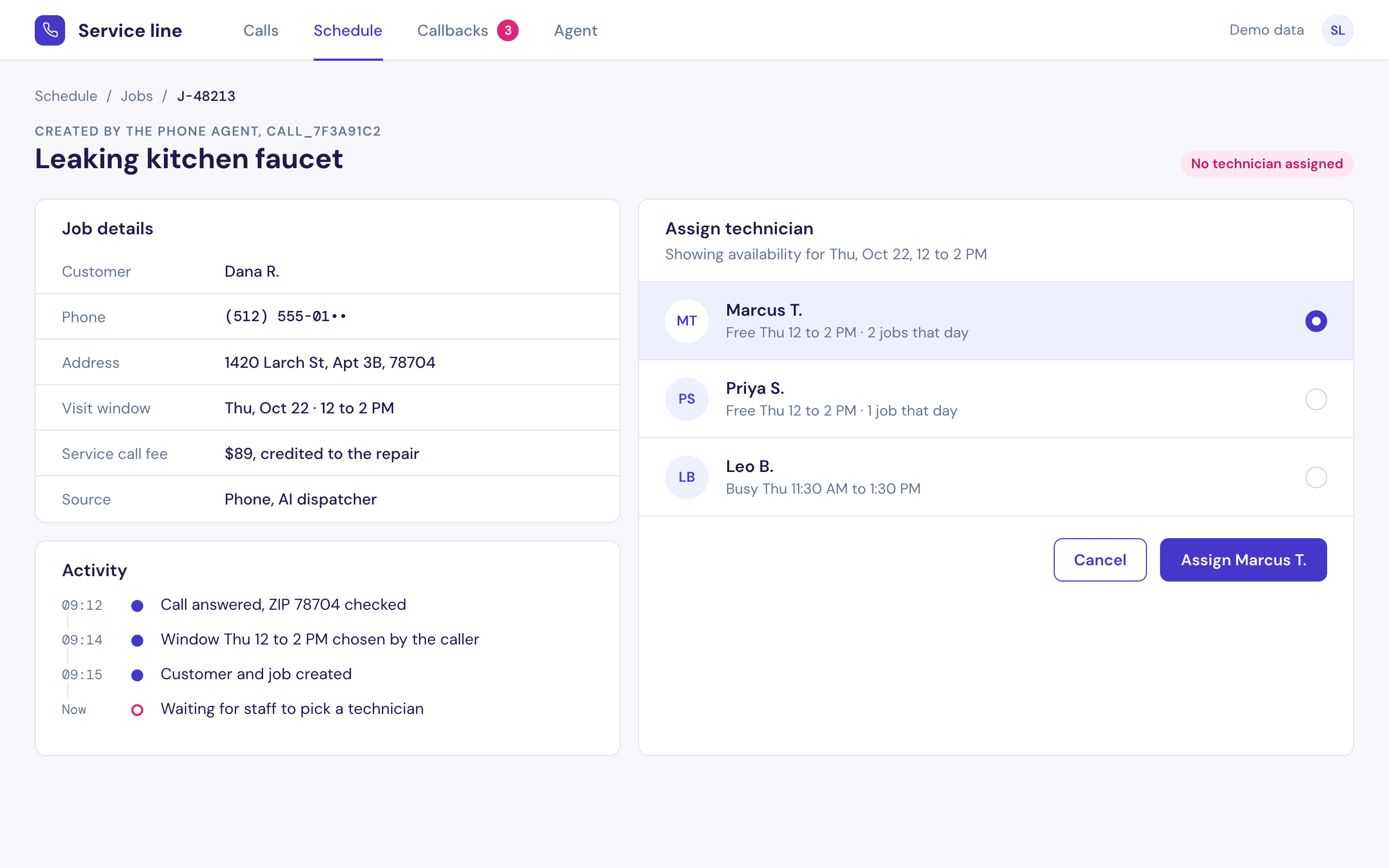
The job as staff see it. The window is already chosen, the technician is not. Redrawn with demo data.
The call history sits next to the schedule. Every call has an outcome, a ZIP, a service and a link to the job it created, so a manager can open any booking and read the conversation behind it.
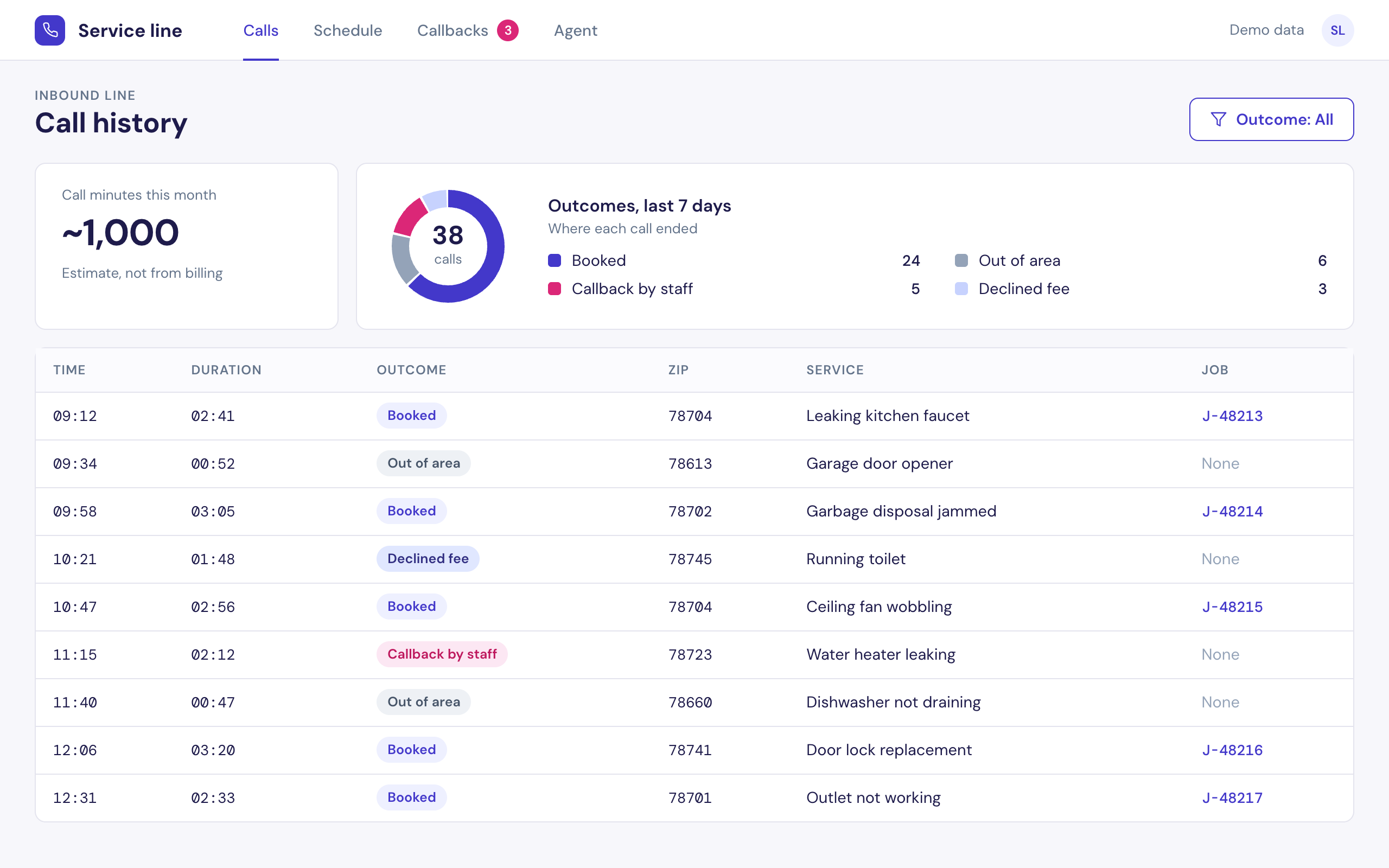
Call history in Retell. Redrawn with demo data.
The hard parts
Turning speech into a job
People do not talk in fields. A caller says "the faucet under my kitchen sink is going, I'm on Larch" and Housecall Pro wants a service, a street, a unit and a phone number. The agent fills named fields as the conversation goes and creates the job only when every required one is complete.
Missing and unclear details
Callers skip the apartment number, give a phone number in two halves or answer a different question than the one asked. The agent asks again for the specific missing piece instead of repeating the whole question, and it moves on after a clear answer so the caller does not hear the same sentence twice.
Windows that change during the call
A fixed schedule offers slots that are already gone. The agent asks Housecall Pro for open windows while the caller is on the line, so the offer matches the calendar at that minute. If the window disappears between the offer and the booking, the agent offers the next one.
Knowing when to hand over
We wrote down the cases where the agent must stop: a ZIP outside the area, a fee the caller declines, no open windows, a failed booking. In each case the caller hears what happens next. The last two put the call into a staff callback list with everything the agent collected, so nobody starts the conversation from zero.
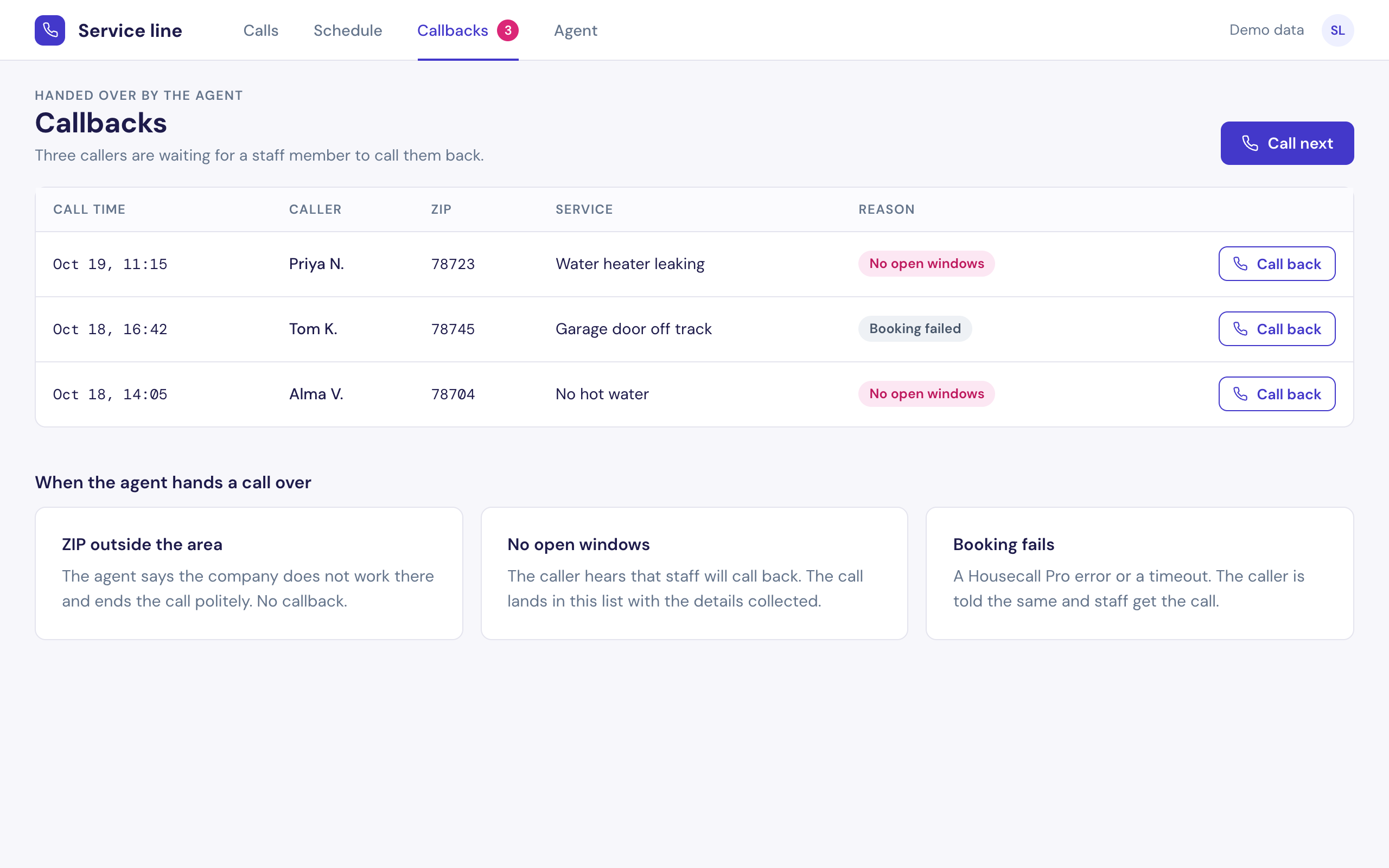
The callback list. Redrawn with demo data.
After launch we listened to real recordings and adjusted the script where callers got confused. Most changes were small: the order of two questions, the way the fee is worded, how the agent repeats an address back.
Result
The AI phone dispatcher runs the company's inbound line in production. The first agent went live on 28 May 2026, and the Housecall Pro integration that lets it book real windows was finished on 27 July 2026. By our estimate, it now handles about 1,000 call minutes a month, a figure that does not come from billing.
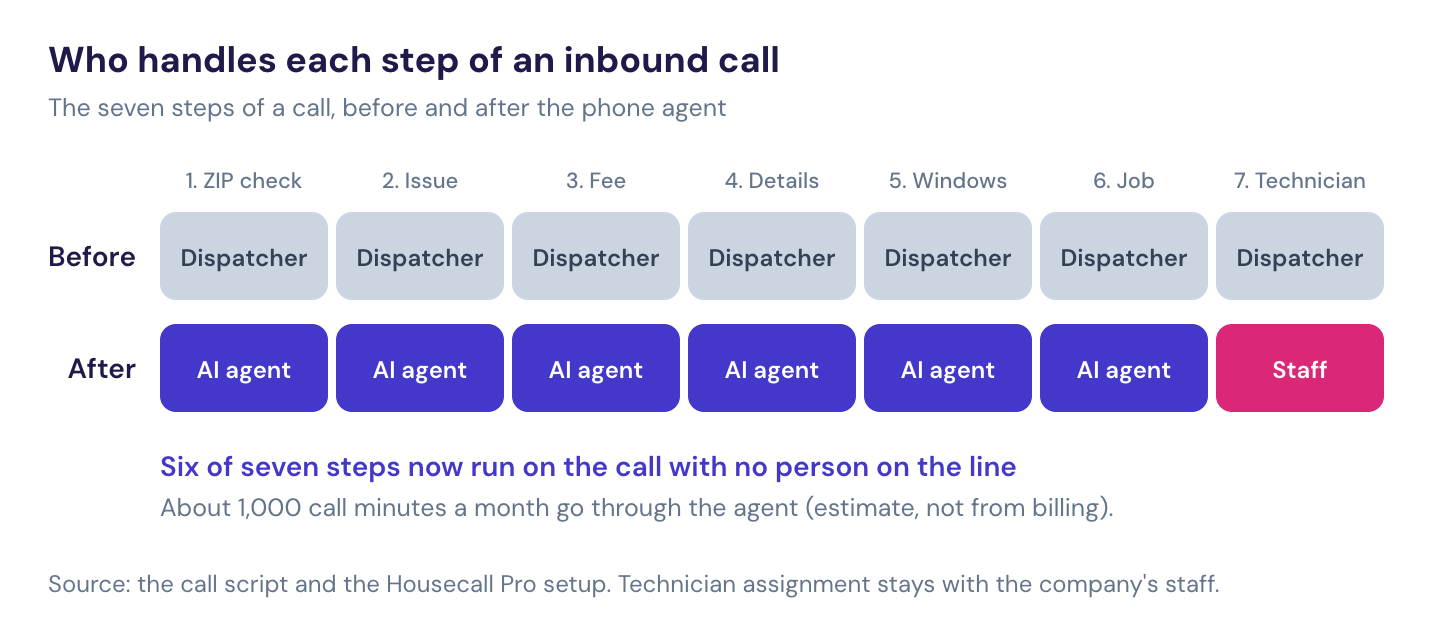
Who handles each step of a call. Technician assignment stays with the company's staff.
| Before | After | |
|---|---|---|
| Who answers a call | One dispatcher, one call at a time | The voice agent, on every call |
| Area check | Done by the dispatcher after hearing the story | First question of the call |
| Windows offered | Looked up by hand | Read from Housecall Pro during the call |
| Job in Housecall Pro | Typed in by the dispatcher | Created before the call ends |
| Failed booking | Easy to lose in a busy hour | A callback with the collected details |
| Staff work | The whole call | Choosing the technician and the callbacks |
The dispatcher's job has changed shape. Nobody takes the repeated questions anymore, and staff open Housecall Pro to a list of jobs that already have an address and a window.
Our part
We built the Retell voice agent, wrote the conversation script, connected Housecall Pro for open windows and job creation, set up the handoff cases and the callback list, and tuned the script on real calls. We still run it. The company decides prices, visit terms and technician assignments, and its technicians do the visits.
The same voice approach works in the other direction, which we covered in the AI outbound calling system. If you are weighing which part of your phone work to hand to AI first, read why businesses automate the wrong things first.
Running a process like this by hand?
Tell us what your team repeats every week. We reply within one business day with a plan and a price.