Automate Invoice Processing: The 2026 Framework for Frictionless Finance
Ready to automate invoice processing? Our 2026 framework uses AI to eliminate manual work, cut costs, and reduce errors for a frictionless finance department.
68% of accounts payable teams still manually key in data in 2026, even though manual processing costs nearly $20 per document. It's a staggering waste of capital and human potential. You likely feel the weight of this inefficiency every time a typo triggers a payment delay or a vendor’s new PDF layout breaks your rigid legacy software. Manual entry is a bottleneck. It's a liability. It's a choice you no longer need to make. We're here to help you automate invoice processing by building a resilient, AI-driven pipeline that scales with your growth.
You'll learn to eliminate manual touchpoints, reduce error rates below 0.1%, and reclaim your team's time for high-value strategy. This guide breaks down the 2026 framework for frictionless finance. We cover everything from specialized OCR models like GLM-OCR to real-time visibility dashboards that keep your operations lean, fast, and invisible. By the end, you'll have a blueprint for a hands-off finance engine that turns administrative friction into competitive speed. Stop managing spreadsheets. Start managing your business.
Key Takeaways
Shift from linear hiring to exponential scaling by treating finance as a high-impact strategic asset rather than a utility.
Replace rigid, template-based software with high-velocity orchestration tools like n8n and Make.com for maximum technical flexibility.
Deploy the Hummingbird Protocol to automate invoice processing and maintain structural integrity even when vendor formats change.
Transition from manual chaos to real-time visibility through a two-phase roadmap focusing on operational audits and bespoke tool selection.
Avoid the "template trap" by building invisible, custom-architected systems that run autonomously without human intervention.
Table of Contents
The High-Velocity Guide to Automating Invoice Processing
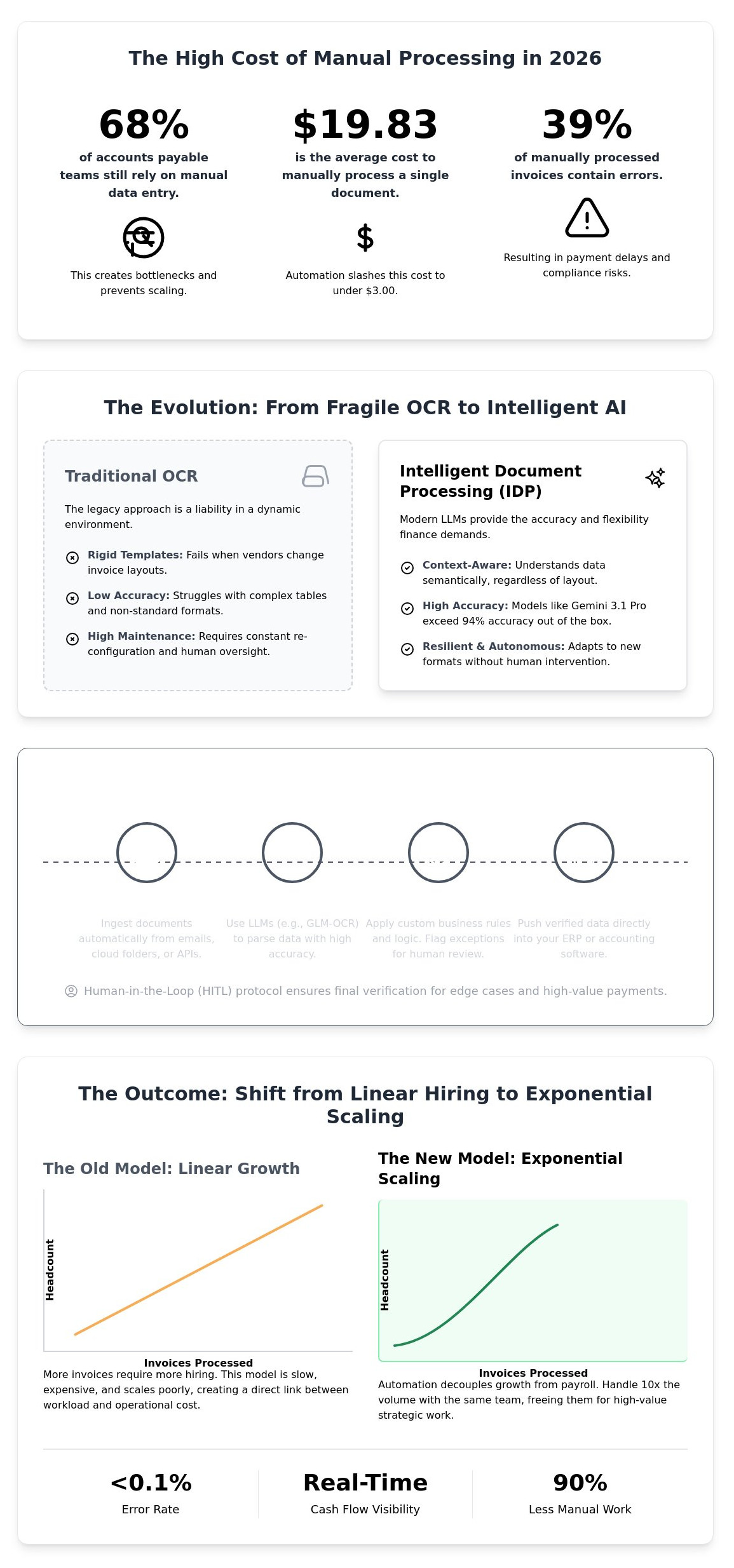
Stop treating your finance department as a back-office utility. It's a strategic operational asset. Most businesses fall into the "Linear Growth" trap. They believe that more invoices require more headcount. This model is broken. It's slow, expensive, and scales poorly. Exponential scaling requires a different approach. You must automate invoice processing to decouple your growth from your payroll. This isn't just about efficiency. It's about structural integrity.
A modern automation pipeline consists of four distinct stages: Capture, Extract, Validate, and Sync. By 2026, the industry moved past traditional OCR. Large Language Models (LLMs) now provide the accuracy required for financial operations. They handle the nuance that legacy systems miss. They don't just see pixels; they understand data. If you're still relying on manual entry, you're operating with a self-imposed handicap. You're choosing friction over flow.
The Hidden Cost of Manual Financial Operations
Manual invoice processing carries a steep "Human Error Tax." Data from 2026 indicates that nearly 39% of manually processed invoices contain errors. These mistakes aren't just annoying. They're expensive. Manual processing costs between $12.88 and $19.83 per document. Automation slashes that to under $3.00. Beyond the balance sheet, there's psychological friction. Administrative bottlenecks drain leadership energy. They distract you from high-level strategy. Manual workflows also create data silos. When information is trapped in paper or static PDFs, you lose real-time visibility into your cash flow. You're flying blind.
Evolution from OCR to Intelligent Document Processing (IDP)
Traditional OCR is fragile. It relies on rigid templates. If a vendor changes a layout or moves a table, the system fails. This creates more work, not less. Intelligent Document Processing (IDP) changed the game. Modern LLMs understand context. They can parse non-standard formats, handwritten notes, and complex tables with surgical precision. Models like Claude 4.6 and Gemini 3.1 Pro now exceed 90% accuracy out of the box. This allows you to automate invoice processing across thousands of vendors without writing a single line of template code. They don't need to be told where the invoice number is. They know what an invoice number looks like. IDP is the synthesis of AI vision and semantic understanding.
The Technical Architecture: OCR, LLMs, and Workflow Orchestration
The most sophisticated systems operate in the background. They are invisible. To effectively automate invoice processing, you shouldn't look for a single software solution. You should build an ecosystem. This "Invisible Engine" approach relies on connecting disparate systems via high-performance APIs. It ensures that data moves fluidly between your inbox, your AI models, and your ERP without manual friction. It replaces human effort with structural precision.
Orchestration is the central nervous system of this architecture. While tools like Zapier are sufficient for simple, linear tasks, they lack the depth required for complex financial operations. Professionals favor n8n and Make.com. These platforms offer advanced error handling, complex branching logic, and the ability to process thousands of line items simultaneously. They turn a simple file transfer into a robust, logical workflow. They allow for the complexity that finance demands.
The data flow is surgical. It begins with ingestion from an email attachment or a cloud folder. From there, specialized models like GLM-OCR or Gemini 3.1 Pro parse the document with high accuracy. The extracted data then hits the orchestration layer for validation and formatting. Finally, the verified data is synced to your CRM or ERP. Despite the speed, high-stakes finance requires a "Human-in-the-loop" (HITL) protocol. Even with AI models achieving accuracy scores over 94%, humans provide the final check for edge cases and high-value payments. If you want to see how these systems fit together, you can explore our approach to bespoke architecture.
Leveraging n8n for Complex Financial Logic
n8n provides the granular control finance teams need. You can build branching logic that treats a $500 utility bill differently than a $50,000 vendor payment. It handles multi-currency conversions and tax-variant invoices automatically. Choosing a self-hosted n8n instance also provides superior data security and significant cost-efficiency compared to cloud-only competitors. It's a lean, powerful choice for scaling operations without increasing overhead.
Integrating AI Agents for Semantic Validation
AI agents go beyond text extraction. They perform semantic validation. This means the system can cross-reference invoice line items against existing purchase orders (POs) to ensure total consistency. It detects anomalies, duplicate billings, and potential fraud before a cent leaves your account. By training an LLM on your specific chart of accounts, you create an "Internal Brain" that understands your business context. It doesn't just read data; it understands its purpose.
Beyond Extraction: Building Resilient Error-Handling Workflows
The biggest objection to automation is simple. What happens when the system breaks? Most finance leaders fear a silent failure where an invoice disappears into a digital void. This fear is valid. Traditional setups are fragile. They lack the structural integrity to handle the chaos of real-world data. To truly automate invoice processing, you must build for failure. You need a system that doesn't just work; it self-corrects. This is the core of the Hummingbird Protocol. It's an approach that prioritizes resilience, accountability, and operational continuity over mere execution.
Silent failures are the enemy of financial scaling. If your system stops processing but doesn't notify anyone, you lose visibility. You miss payments. You damage vendor relationships. A professional architecture includes automated alerts and fallback queues. It ensures that every document is accounted for, even when the AI is uncertain. We don't aim for 100% automation. We aim for 100% accountability. This requires a shift from linear workflows to resilient, multi-path ecosystems that can absorb shocks without breaking. You stop being a technician and start being an architect of invisible systems.
Why Your Current Workflows Are Breaking
Workflows break because they are too rigid. Many businesses use template-based systems that fail when a vendor changes a single margin. API rate limits also cause issues. In high-volume environments, hitting a limit can halt your entire pipeline. OCR models can still misread characters; an "O" becomes a "0," and the sync to your ERP fails. These aren't just glitches. They are operational risks that demand a strategic response.
Architecting for Stability: Fallbacks and Retries
Stability requires a Dead Letter Queue (DLQ). This is a staging area for invoices that fail extraction or validation. Instead of disappearing, these documents trigger immediate Slack or email notifications for high-priority exceptions. Every step is logged. Every retry is tracked. Every document is accounted for. This creates a transparent trail for financial audits. By building these fallbacks, you turn a fragile process into a resilient engine. You gain speed, precision, and absolute control.
Implementation Roadmap: From Manual Chaos to Real-Time Insights
Execution is the only differentiator. You've understood the tech; now you need the path. Implementation follows a four-phase sequence designed for speed and structural integrity. This isn't a software installation. It's a structural overhaul of your finance department. We move from identifying bottlenecks to deploying an invisible engine that runs itself. Speed is the priority. Precision is the standard.
Phase 1: Operational Audit. You can't automate what you don't understand. Map every entry point. Does the invoice arrive via a Slack DM, a shared inbox, or physical mail? Identify the gatekeepers. Who signs off? Where is the final destination? Most businesses find that their "process" is actually a series of undocumented habits.
Phase 2: Tool Selection. Don't buy a rigid suite. Build a high-velocity stack. Match n8n for orchestration, LLMs for semantic extraction, and your existing CRM for data storage. This ensures your system remains flexible as your business evolves.
Phase 3: Pilot Build. Choose your highest-volume vendor. Automate that single stream first. It's the fastest way to automate invoice processing while proving the ROI to stakeholders. Fix the edge cases here before you scale.
Phase 4: Full Scale and Integration. Deploy across all vendors. Connect the output to real-time dashboards. This phase moves your team from manual data entry to high-level financial oversight.
Auditing Your Current Financial Friction
Approval limbo is where cash flow dies. You must identify where the "paper trail" actually starts. It's rarely just an email. It's often a fragmented mess of Slack messages and physical mail. Map the approval hierarchy with surgical precision. If your CFO only needs to see invoices over $5,000, build that logic into the code. Document every hop from ingestion to archival. This map becomes the blueprint for your invisible system.
Turning Data into Truth: Real-Time Dashboards
Data is useless if it stays trapped in an ERP. Connecting your pipeline to a live dashboard turns raw numbers into strategic truth. Visualize your cash flow. Track vendor performance. Monitor processing speed. For a CEO, real-time insights are the ultimate competitive advantage. You stop guessing. You start executing. You gain the intellectual relief that comes from knowing your numbers are accurate and up to date. If you're ready to build this engine, book a high-velocity briefing with our team.
By the time you reach full scale, your finance team isn't typing. They are analyzing. They are looking at the dashboards you built to identify cost-saving opportunities and negotiation leverage. You've turned a cost center into a value driver. You've used the power to automate invoice processing to buy back your team's time and your company's future.
Bespoke Automation Systems: Why PASMO Outperforms Off-the-Shelf
Off-the-shelf software is a band-aid. It's built for the "average" business, which means it's built for no one. Most SaaS providers lure you into the "Template Trap." They force your unique financial operations into their rigid, pre-defined boxes. If your vendor changes a layout, the system breaks. If your approval hierarchy shifts, you're stuck waiting for a support ticket. PASMO rejects this model. We build bespoke architecture. We create "Invisible Systems" that adapt to your specific logic, your unique vendors, and your existing tech stack. These systems require zero human thought once they're running. They don't just process data; they execute your strategy.
The long-term ROI of bespoke systems is undeniable. Traditional SaaS models charge you a per-invoice fee. This is a tax on your growth. The more you succeed, the more you pay. When you automate invoice processing through a PASMO-designed ecosystem, you own the workflow logic. We deploy tools like n8n that you control. You move from a variable, scaling expense to a fixed, high-value asset. You stop renting your efficiency and start owning your infrastructure. It's the difference between a temporary fix and a permanent competitive advantage. We position your business as a surgical leader in your industry.
The Hummingbird Protocol: Speed, Precision, Seamlessness
Our philosophy is rooted in the Hummingbird Protocol. It represents the synthesis of rapid deployment and structural integrity. We don't spend months in the planning phase while your team drowns in paperwork. We audit. We build. We scale. Our approach is designed to reduce manual labor hours by 90% without adding a single person to your headcount. We identify the friction, eliminate the noise, and connect the systems. You get the intellectual relief of a solved problem. You get a finance engine that is lean, fast, and unapologetically efficient. We don't just help you automate invoice processing; we help you outpace the market.
Ready to Scale Without Friction?
Scaling with people is a legacy strategy. It's slow. It's prone to error. It's expensive. The future of finance is a hands-off pipeline that provides real-time truth to leadership. You have a choice. You can continue to manage administrative bottlenecks, or you can deploy an invisible force that handles the heavy lifting for you. It's time to stop fighting your tools and start leveraging your data. We're ready to audit your operations and build the engine your growth demands. The path to frictionless finance starts with a single decision. Build your frictionless finance system with PASMO and reclaim your team's potential today.
Architect Your Frictionless Finance Engine
Manual data entry is a relic of a slower era. It's a persistent drag on your company's growth. You've seen the roadmap to automate invoice processing using the synthesis of LLMs and robust orchestration. You understand that resilient error-handling is the only way to prevent silent failures and data silos. You know that bespoke architecture beats the "Template Trap" every time. It's time to stop renting generic software and start owning your operational logic. Own your speed. Own your data. Own your future.
PASMO builds these invisible engines with surgical precision. We utilize the Hummingbird Protocol to deliver speed, structural integrity, and immediate operational relief. Our deep expertise in n8n and AI-driven workflows ensures your finance pipeline scales effortlessly without increasing your headcount. We prioritize measurable impact, technical superiority, and high-velocity execution. Stop managing administrative bottlenecks. Start leading your industry with a system that works while you sleep. Eliminate manual labor and scale your operations with PASMO. Your future is frictionless.
Frequently Asked Questions
How accurate is AI at extracting data from invoices?
Modern AI models achieve accuracy rates exceeding 94% out of the box. Frontier LLMs like Gemini 3.1 Pro and Claude 4.6 parse complex document structures with surgical precision. They outperform traditional OCR by understanding semantic context rather than just reading pixels. This reduces human intervention to a high-level verification step. It ensures your data is clean, reliable, and ready for sync.
Can I automate invoice processing if my vendors use different languages or currencies?
Yes, modern LLMs are natively multi-lingual and handle diverse currencies without extra configuration. They automatically detect the language and convert foreign totals based on your specific business rules. This allows you to automate invoice processing across global operations seamlessly. You stop building region-specific workflows. You start scaling a single, unified engine.
How long does it typically take to implement a custom invoice automation system?
A pilot build for your highest-volume vendor typically takes two to four weeks. This rapid deployment proves ROI and allows for immediate operational relief. Full-scale implementation across your entire vendor list usually follows within six to eight weeks. We prioritize speed, precision, and structural integrity. We build while others are still planning.
Will I need to change my existing accounting software or ERP?
No, our architecture is designed to be "invisible" and non-disruptive. We connect to your existing stack via high-performance APIs to sync data directly into your current environment. Whether you use NetSuite, SAP, or QuickBooks, the automation layer sits on top of your current tools. You gain efficiency without the friction of a software migration.
What is the difference between Zapier and n8n for invoice processing?
n8n provides the technical depth and logical branching that Zapier lacks. While Zapier is sufficient for simple tasks, n8n allows for complex error handling and self-hosting for superior data security. It is the professional choice to automate invoice processing at scale. It offers more flexibility, better cost-efficiency, and deeper control over your financial logic.
How does automated invoice processing detect fraudulent or duplicate bills?
AI agents cross-reference every incoming document against your historical database and purchase orders. They instantly flag duplicate invoice numbers, anomalous line items, or mismatched banking details. This creates a proactive defense layer that stops errors and fraud before they reach your payment queue. You gain security through automated vigilance.
Is it possible to automate the approval workflow as well as the data entry?
Yes, we build custom logic that routes invoices based on department, amount, or vendor type. High-value bills trigger immediate Slack or email notifications for executive sign-off, while low-risk recurring payments can be auto-approved. This eliminates approval limbo. It turns a manual bottleneck into a high-speed, logical flow.
What happens if the AI fails to read an invoice correctly?
The system triggers a "Human-in-the-loop" protocol. Any invoice falling below a specific confidence threshold is automatically routed to a Dead Letter Queue for manual review. This ensures 100% accountability and prevents corrupted data from entering your ERP. It is a resilient architecture designed to handle edge cases without breaking the pipeline.